
stouputils.parallel module#
This module provides utility functions for parallel processing, such as:
multiprocessing(): Execute a function in parallel using multiprocessing
multithreading(): Execute a function in parallel using multithreading
run_in_subprocess(): Execute a function in a subprocess with args and kwargs
I highly encourage you to read the function docstrings to understand when to use each method.
Priority (nice) mapping for multiprocessing():
Unix-style values from -20 (highest priority) to 19 (lowest priority)
Windows automatic mapping: * -20 to -10: HIGH_PRIORITY_CLASS * -9 to -1: ABOVE_NORMAL_PRIORITY_CLASS * 0: NORMAL_PRIORITY_CLASS * 1 to 9: BELOW_NORMAL_PRIORITY_CLASS * 10 to 19: IDLE_PRIORITY_CLASS
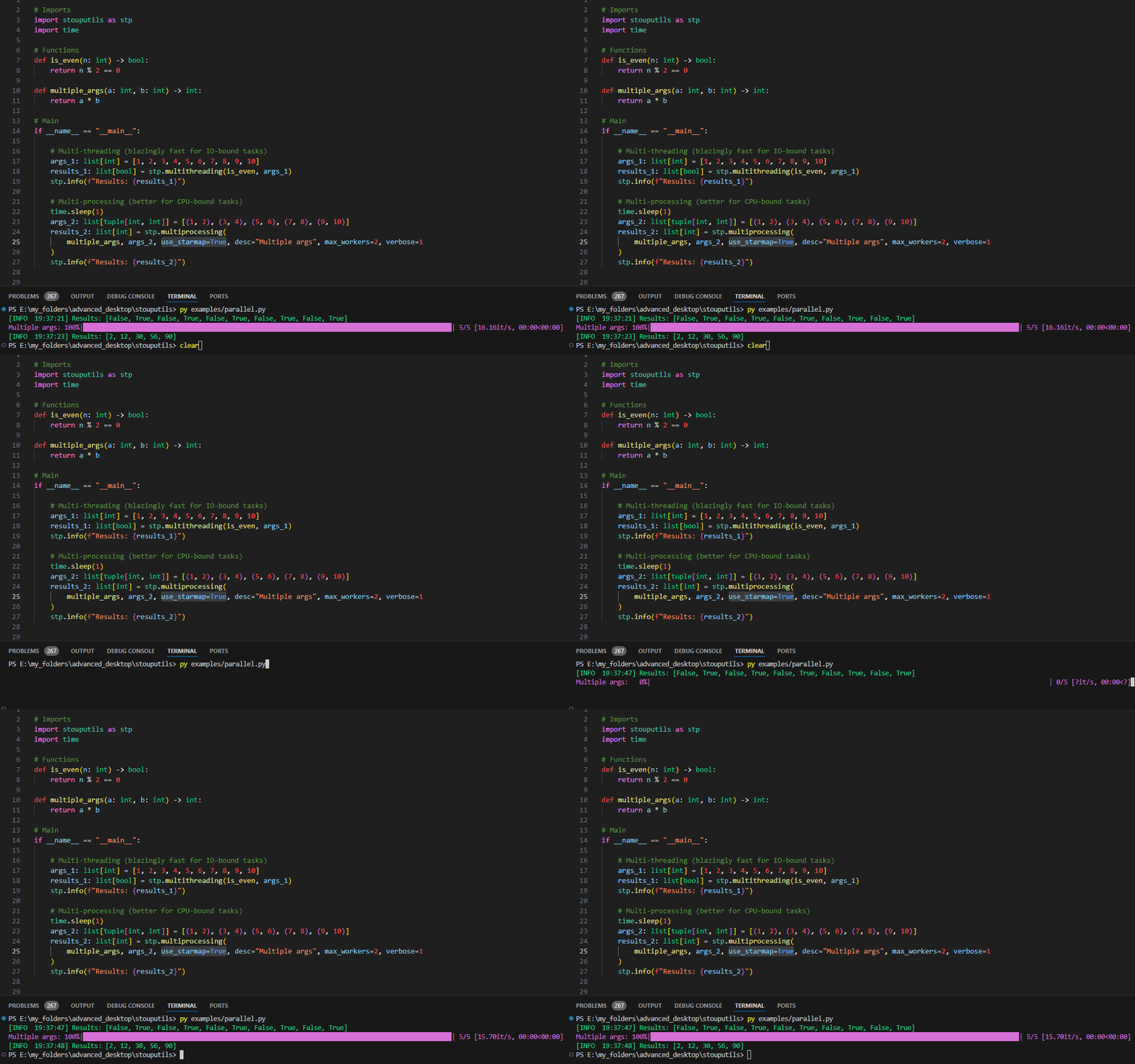
- multiprocessing(
- func: Callable[[...], R] | list[Callable[[...], R]],
- args: Iterable,
- use_starmap: bool = False,
- chunksize: int = 1,
- desc: str = '',
- max_workers: int | float = 4,
- delay_first_calls: float = 0,
- nice: int | None = None,
- color: str = '\x1b[95m',
- bar_format: str = '{l_bar}{bar}\x1b[95m| {n_fmt}/{total_fmt} [{rate_fmt}{postfix}, {elapsed}<{remaining}]\x1b[0m',
- ascii: bool = False,
- smooth_tqdm: bool = True,
- **tqdm_kwargs: Any,
Method to execute a function in parallel using multiprocessing
For CPU-bound operations where the GIL (Global Interpreter Lock) is a bottleneck.
When the task can be divided into smaller, independent sub-tasks that can be executed concurrently.
For computationally intensive tasks like scientific simulations, data analysis, or machine learning workloads.
- Parameters:
func (Callable | list[Callable]) – Function to execute, or list of functions (one per argument)
args (Iterable) – Iterable of arguments to pass to the function(s)
use_starmap (bool) – Whether to use starmap or not (Defaults to False): True means the function will be called like func(*args[i]) instead of func(args[i])
chunksize (int) – Number of arguments to process at a time (Defaults to 1 for proper progress bar display)
desc (str) – Description displayed in the progress bar (if not provided no progress bar will be displayed)
max_workers (int | float) – Number of workers to use (Defaults to CPU_COUNT), -1 means CPU_COUNT. If float between 0 and 1, it’s treated as a percentage of CPU_COUNT. If negative float between -1 and 0, it’s treated as a percentage of len(args).
delay_first_calls (float) – Apply i*delay_first_calls seconds delay to the first “max_workers” calls. For instance, the first process will be delayed by 0 seconds, the second by 1 second, etc. (Defaults to 0): This can be useful to avoid functions being called in the same second.
nice (int | None) – Adjust the priority of worker processes (Defaults to None). Use Unix-style values: -20 (highest priority) to 19 (lowest priority). Positive values reduce priority, negative values increase it. Automatically converted to appropriate priority class on Windows. If None, no priority adjustment is made.
color (str) – Color of the progress bar (Defaults to MAGENTA)
bar_format (str) – Format of the progress bar (Defaults to BAR_FORMAT)
ascii (bool) – Whether to use ASCII or Unicode characters for the progress bar
smooth_tqdm (bool) – Whether to enable smooth progress bar updates by setting miniters and mininterval (Defaults to True)
**tqdm_kwargs (Any) – Additional keyword arguments to pass to tqdm
- Returns:
Results of the function execution
- Return type:
list[object]
Examples
> multiprocessing(doctest_square, args=[1, 2, 3])
[1, 4, 9]

> multiprocessing(int.__mul__, [(1,2), (3,4), (5,6)], use_starmap=True)
[2, 12, 30]

> # Using a list of functions (one per argument)
> multiprocessing([doctest_square, doctest_square, doctest_square], [1, 2, 3])
[1, 4, 9]

> # Will process in parallel with progress bar
> multiprocessing(doctest_slow, range(10), desc="Processing")
[0, 1, 2, 3, 4, 5, 6, 7, 8, 9]

> # Will process in parallel with progress bar and delay the first threads
> multiprocessing(
.     doctest_slow,
.     range(10),
.     desc="Processing with delay",
.     max_workers=2,
.     delay_first_calls=0.6
. )
[0, 1, 2, 3, 4, 5, 6, 7, 8, 9]
- multithreading(
- func: Callable[[...], R] | list[Callable[[...], R]],
- args: Iterable,
- use_starmap: bool = False,
- desc: str = '',
- max_workers: int | float = 4,
- delay_first_calls: float = 0,
- color: str = '\x1b[95m',
- bar_format: str = '{l_bar}{bar}\x1b[95m| {n_fmt}/{total_fmt} [{rate_fmt}{postfix}, {elapsed}<{remaining}]\x1b[0m',
- ascii: bool = False,
- smooth_tqdm: bool = True,
- **tqdm_kwargs: Any,
Method to execute a function in parallel using multithreading, you should use it:
For I/O-bound operations where the GIL is not a bottleneck, such as network requests or disk operations.
When the task involves waiting for external resources, such as network responses or user input.
For operations that involve a lot of waiting, such as GUI event handling or handling user input.
- Parameters:
func (Callable | list[Callable]) – Function to execute, or list of functions (one per argument)
args (Iterable) – Iterable of arguments to pass to the function(s)
use_starmap (bool) – Whether to use starmap or not (Defaults to False): True means the function will be called like func(*args[i]) instead of func(args[i])
desc (str) – Description displayed in the progress bar (if not provided no progress bar will be displayed)
max_workers (int | float) – Number of workers to use (Defaults to CPU_COUNT), -1 means CPU_COUNT. If float between 0 and 1, it’s treated as a percentage of CPU_COUNT. If negative float between -1 and 0, it’s treated as a percentage of len(args).
delay_first_calls (float) – Apply i*delay_first_calls seconds delay to the first “max_workers” calls. For instance with value to 1, the first thread will be delayed by 0 seconds, the second by 1 second, etc. (Defaults to 0): This can be useful to avoid functions being called in the same second.
color (str) – Color of the progress bar (Defaults to MAGENTA)
bar_format (str) – Format of the progress bar (Defaults to BAR_FORMAT)
ascii (bool) – Whether to use ASCII or Unicode characters for the progress bar
smooth_tqdm (bool) – Whether to enable smooth progress bar updates by setting miniters and mininterval (Defaults to True)
**tqdm_kwargs (Any) – Additional keyword arguments to pass to tqdm
- Returns:
Results of the function execution
- Return type:
list[object]
Examples
> multithreading(doctest_square, args=[1, 2, 3])
[1, 4, 9]

> multithreading(int.__mul__, [(1,2), (3,4), (5,6)], use_starmap=True)
[2, 12, 30]

> # Using a list of functions (one per argument)
> multithreading([doctest_square, doctest_square, doctest_square], [1, 2, 3])
[1, 4, 9]

> # Will process in parallel with progress bar
> multithreading(doctest_slow, range(10), desc="Threading")
[0, 1, 2, 3, 4, 5, 6, 7, 8, 9]

> # Will process in parallel with progress bar and delay the first threads
> multithreading(
.     doctest_slow,
.     range(10),
.     desc="Threading with delay",
.     max_workers=2,
.     delay_first_calls=0.6
. )
[0, 1, 2, 3, 4, 5, 6, 7, 8, 9]
- run_in_subprocess(
- func: Callable[[...], R],
- *args: Any,
- timeout: float | None = None,
- no_join: bool = False,
- **kwargs: Any,
Execute a function in a subprocess with positional and keyword arguments.
This is useful when you need to run a function in isolation to avoid memory leaks, resource conflicts, or to ensure a clean execution environment. The subprocess will be created, run the function with the provided arguments, and return the result.
- Parameters:
func (Callable) – The function to execute in a subprocess. (SHOULD BE A TOP-LEVEL FUNCTION TO BE PICKLABLE)
*args (Any) – Positional arguments to pass to the function.
timeout (float | None) – Maximum time in seconds to wait for the subprocess. If None, wait indefinitely. If the subprocess exceeds this time, it will be terminated.
no_join (bool) – If True, do not wait for the subprocess to finish (fire-and-forget).
**kwargs (Any) – Keyword arguments to pass to the function.
- Returns:
The return value of the function.
- Return type:
R
- Raises:
RuntimeError – If the subprocess exits with a non-zero exit code or times out.
TimeoutError – If the subprocess exceeds the specified timeout.
Examples
> # Simple function execution
> run_in_subprocess(doctest_square, 5)
25

> # Function with multiple arguments
> def add(a: int, b: int) -> int:
.     return a + b
> run_in_subprocess(add, 10, 20)
30

> # Function with keyword arguments
> def greet(name: str, greeting: str = "Hello") -> str:
.     return f"{greeting}, {name}!"
> run_in_subprocess(greet, "World", greeting="Hi")
'Hi, World!'

> # With timeout to prevent hanging
> run_in_subprocess(some_gpu_func, data, timeout=300.0)
- _nice_wrapper(
- args: tuple[int, Callable[[T], R], T],
Wrapper that applies nice priority then executes the function.
- Parameters:
args (tuple) – Tuple containing (nice_value, func, arg)
- Returns:
Result of the function execution
- Return type:
R
- _set_process_priority(nice_value: int) None[source]#
Set the priority of the current process.
- Parameters:
nice_value (int) – Unix-style priority value (-20 to 19)
- _subprocess_wrapper(
- result_queue: Any,
- func: Callable[[...], R],
- args: tuple[Any, ...],
- kwargs: dict[str, Any],
Wrapper function to execute the target function and store the result in the queue.
Must be at module level to be pickable on Windows (spawn context).
- Parameters:
result_queue (multiprocessing.Queue | None) – Queue to store the result or exception (None if detached).
func (Callable) – The target function to execute.
args (tuple) – Positional arguments for the function.
kwargs (dict) – Keyword arguments for the function.
- _starmap(
- args: tuple[Callable[[T], R], list[T]],
Private function to use starmap using args[0](*args[1])
- Parameters:
args (tuple) – Tuple containing the function and the arguments list to pass to the function
- Returns:
Result of the function execution
- Return type:
object
- _delayed_call(
- args: tuple[Callable[[T], R], float, T],
Private function to apply delay before calling the target function
- Parameters:
args (tuple) – Tuple containing the function, delay in seconds, and the argument to pass to the function
- Returns:
Result of the function execution
- Return type:
object
- _handle_parameters(
- func: Callable[[T], R] | list[Callable[[T], R]],
- args: list[T],
- use_starmap: bool,
- delay_first_calls: float,
- max_workers: int,
- desc: str,
- color: str,
Private function to handle the parameters for multiprocessing or multithreading functions
- Parameters:
func (Callable | list[Callable]) – Function to execute, or list of functions (one per argument)
args (list) – List of arguments to pass to the function(s)
use_starmap (bool) – Whether to use starmap or not (Defaults to False): True means the function will be called like func(*args[i]) instead of func(args[i])
delay_first_calls (int) – Apply i*delay_first_calls seconds delay to the first “max_workers” calls. For instance, the first process will be delayed by 0 seconds, the second by 1 second, etc. (Defaults to 0): This can be useful to avoid functions being called in the same second.
max_workers (int) – Number of workers to use (Defaults to CPU_COUNT)
desc (str) – Description of the function execution displayed in the progress bar
color (str) – Color of the progress bar
- Returns:
Tuple containing the description, function, and arguments
- Return type:
tuple[str, Callable[[T], R], list[T]]