
stouputils.ctx module#
This module provides context managers for various utilities such as logging to a file, measuring execution time, silencing output, and setting multiprocessing start methods.
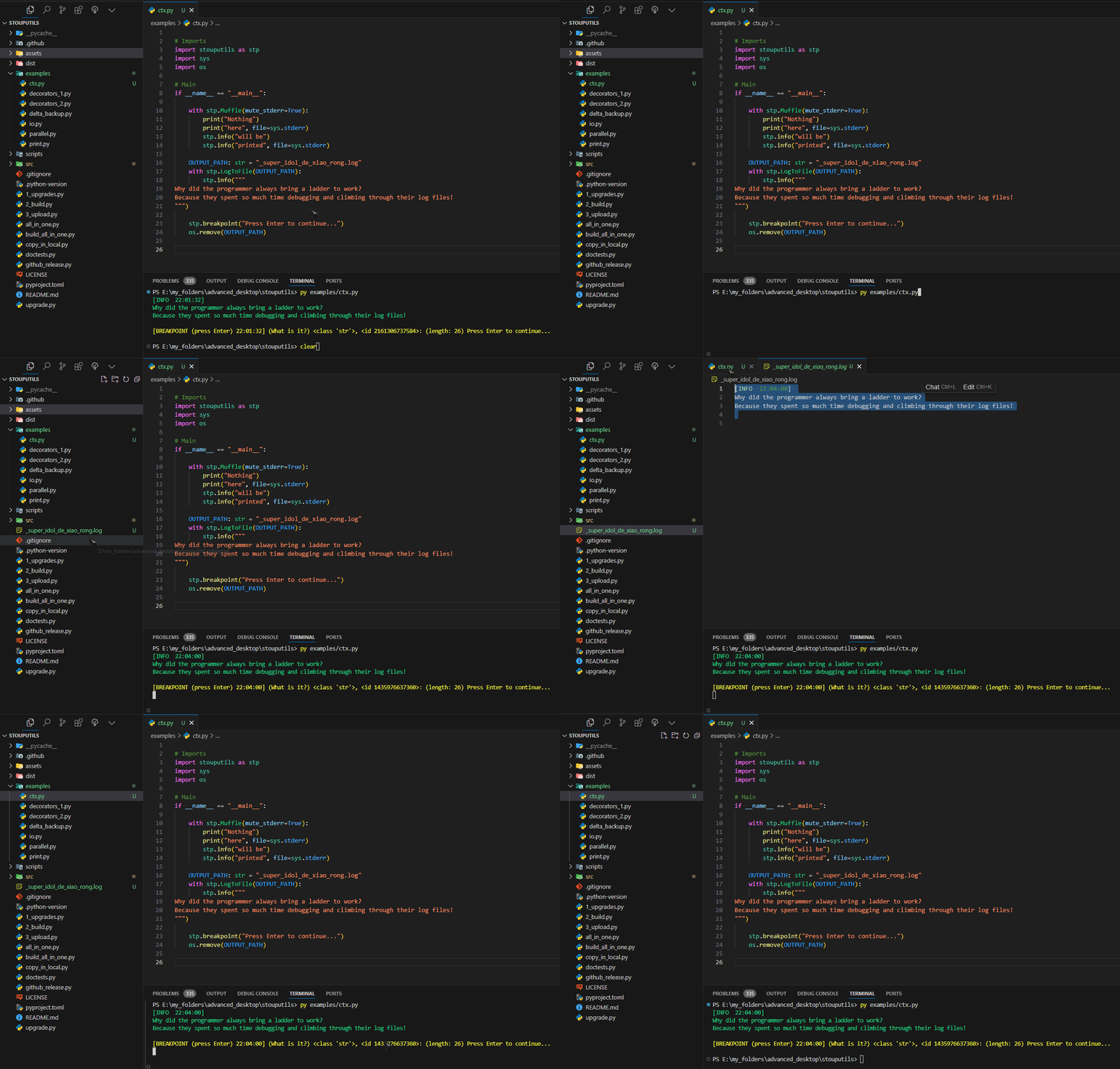
LogToFile: Context manager to log to a file every print call (with LINE_UP handling)
MeasureTime: Context manager to measure execution time of a code block
Muffle: Context manager that temporarily silences output (alternative to stouputils.decorators.silent())
DoNothing: Context manager that does nothing (no-op)
SetMPStartMethod: Context manager to temporarily set multiprocessing start method
- class AbstractBothContextManager[source]#
Bases:
AbstractContextManager,AbstractAsyncContextManager,GenericAbstract base class for context managers that support both synchronous and asynchronous usage.
- _abc_impl = <_abc._abc_data object>#
- class LogToFile(
- path: str,
- mode: str = 'w',
- encoding: str = 'utf-8',
- tee_stdout: bool = True,
- tee_stderr: bool = True,
- ignore_lineup: bool = True,
- restore_on_exit: bool = False,
Bases:
AbstractBothContextManager[LogToFile]Context manager to log to a file.
This context manager allows you to temporarily log output to a file while still printing normally. The file will receive log messages without ANSI color codes.
- Parameters:
path (str) – Path to the log file
mode (str) – Mode to open the file in (default: “w”)
encoding (str) – Encoding to use for the file (default: “utf-8”)
tee_stdout (bool) – Whether to redirect stdout to the file (default: True)
tee_stderr (bool) – Whether to redirect stderr to the file (default: True)
ignore_lineup (bool) – Whether to ignore lines containing LINE_UP escape sequence in files (default: False)
restore_on_exit (bool) – Whether to restore original stdout/stderr on exit (default: False) This ctx uses TeeMultiOutput which handles closed files gracefully, so restoring is not mandatory.
Examples
> import stouputils as stp
> with stp.LogToFile("output.log"):
>     stp.info("This will be logged to output.log and printed normally")
>     print("This will also be logged")

> with stp.LogToFile("output.log") as log_ctx:
>     stp.warning("This will be logged to output.log and printed normally")
>     log_ctx.change_file("new_file.log")
>     print("This will be logged to new_file.log")
- path: str#
Attribute remembering path to the log file
- mode: str#
Attribute remembering mode to open the file in
- encoding: str#
Attribute remembering encoding to use for the file
- tee_stdout: bool#
Whether to redirect stdout to the file
- tee_stderr: bool#
Whether to redirect stderr to the file
- ignore_lineup: bool#
Whether to ignore lines containing LINE_UP escape sequence in files
- restore_on_exit: bool#
Whether to restore original stdout/stderr on exit. This ctx uses TeeMultiOutput which handles closed files gracefully, so restoring is not mandatory.
- file: IO[Any]#
Attribute remembering opened file
- original_stdout: TextIO#
Original stdout before redirection
- original_stderr: TextIO#
Original stderr before redirection
- change_file(new_path: str) None[source]#
Change the log file to a new path.
- Parameters:
new_path (str) – New path to the log file
- static common(
- logs_folder: str,
- filepath: str,
- func: Callable[[...], Any],
- *args: Any,
- **kwargs: Any,
Common code used at the beginning of a program to launch main function
- Parameters:
logs_folder (str) – Folder to store logs in
filepath (str) – Path to the main function
func (Callable[..., Any]) – Main function to launch
*args (tuple[Any, ...]) – Arguments to pass to the main function
**kwargs (dict[str, Any]) – Keyword arguments to pass to the main function
- Returns:
Return value of the main function
- Return type:
Any
Examples
>>> if __name__ == "__main__":
...     LogToFile.common(f"{ROOT}/logs", __file__, main)
- _abc_impl = <_abc._abc_data object>#
- class MeasureTime(print_func: ~collections.abc.Callable[[...], None] = <function debug>, message: str = 'Execution time', perf_counter: bool = True)[source]#
Bases:
AbstractBothContextManager[MeasureTime]Context manager to measure execution time.
This context manager measures the execution time of the code block it wraps and prints the result using a specified print function.
- Parameters:
print_func (Callable) – Function to use to print the execution time (e.g. debug, info, warning, error, etc.).
message (str) – Message to display with the execution time. Defaults to “Execution time”.
perf_counter (bool) – Whether to use time.perf_counter_ns or time.time_ns. Defaults to True.
Examples
> import time
> import stouputils as stp
> with stp.MeasureTime(stp.info, message="My operation"):
...     time.sleep(0.5)
> # [INFO HH:MM:SS] My operation: 500.123ms (500123456ns)

> with stp.MeasureTime(): # Uses debug by default
...     time.sleep(0.1)
> # [DEBUG HH:MM:SS] Execution time: 100.456ms (100456789ns)
- print_func: Callable[[...], None]#
Function to use for printing the execution time
- message: str#
Message to display with the execution time
- perf_counter: bool#
Whether to use time.perf_counter_ns or time.time_ns
- ns: Callable[[], int]#
Time function to use
- start_ns: int#
Start time in nanoseconds
- _abc_impl = <_abc._abc_data object>#
- class Muffle(mute_stderr: bool = False)[source]#
Bases:
AbstractBothContextManager[Muffle]Context manager that temporarily silences output. (No thread-safety guaranteed)
Alternative to stouputils.decorators.silent()
Examples
>>> with Muffle():
...     print("This will not be printed")
- mute_stderr: bool#
Attribute remembering if stderr should be muted
- original_stdout: IO[Any]#
Attribute remembering original stdout
- original_stderr: IO[Any]#
Attribute remembering original stderr
- _abc_impl = <_abc._abc_data object>#
- class DoNothing(*args: Any, **kwargs: Any)[source]#
Bases:
AbstractBothContextManager[DoNothing]Context manager that does nothing.
This is a no-op context manager that can be used as a placeholder or for conditional context management.
Different from contextlib.nullcontext because it handles args and kwargs, along with async context management.
Examples
>>> with DoNothing():
...     print("This will be printed normally")
This will be printed normally
>>> # Conditional context management
>>> some_condition = True
>>> ctx = DoNothing() if some_condition else Muffle()
>>> with ctx:
...     print("May or may not be printed depending on condition")
May or may not be printed depending on condition
- _abc_impl = <_abc._abc_data object>#
- NullContextManager#
Alias for DoNothing context manager
- class SetMPStartMethod(start_method: str | None)[source]#
Bases:
AbstractBothContextManager[SetMPStartMethod]Context manager to temporarily set multiprocessing start method.
This context manager allows you to temporarily change the multiprocessing start method and automatically restores the original method when exiting the context.
- Parameters:
start_method (str) – The start method to use: “spawn”, “fork”, or “forkserver”
Examples
> import multiprocessing as mp
> import stouputils as stp
> # Temporarily use spawn method
> with stp.SetMPStartMethod("spawn"):
> ...     # Your multiprocessing code here
> ...     pass

> # Original method is automatically restored
- _abc_impl = <_abc._abc_data object>#
- start_method: str | None#
The start method to use
- old_method: str | None#
The original start method to restore