
API reference#
Stouputils is a collection of utility modules designed to simplify and enhance the development process. It includes a range of tools for tasks such as execution of doctests, display utilities, decorators, as well as context managers.
Check the documentation for more details: https://stoupy51.github.io/stouputils/
⚙️ config#
Global configuration module for stouputils.
This module provides the StouputilsConfig class which contains global configuration options that control the behavior of various stouputils functions. Configuration values can be set programmatically or via environment variables.
- Environment Variables:
Configuration options can be overridden using environment variables with the prefix
STP_orSTOUPUTILS_followed by the configuration variable name. STP_PROCESS_TITLE_PER_WORKER=false STOUPUTILS_PROCESS_TITLE_PER_WORKER=true- Usage:
from stouputils.config import StouputilsConfig as Cfg

# Change configuration programmatically
Cfg.PROCESS_TITLE_PER_WORKER = False
- ENV_PARSERS: dict[str, Callable[[str], Any]] = {'bool': <function <lambda>>, 'float': <class 'float'>, 'int': <class 'int'>}[source]#
How an environment variable is read, by the type name of the option it overrides. Any other type keeps the string.
- class StouputilsConfig[source]#
Bases:
objectGlobal configuration class for stouputils.
- VERBOSE_READING_ENV: bool = False[source]#
Configuration option for verbose output when reading environment variables when stouputils is imported.
If true, stouputils will print out the environment variables it reads and their values. Defaults to False.
- BOLD: str = '\x1b[1m'[source]#
Terminal color/style constants used throughout the package.
Used by
stouputils.printand the other modules printing colored text, such asstouputils.backup.
- BAR_FORMAT: str = '{l_bar}{bar}\x1b[95m| {n_fmt}/{total_fmt} [{rate_fmt}{postfix}, {elapsed}<{remaining}]\x1b[0m'[source]#
Default bar format used for TQDM progress bars.
Used by:
stouputils.printandstouputils.parallelfor progress bars.
- FORCE_RAISE_EXCEPTION: bool = False[source]#
If true, error_log parameter will be set to
LogLevels.RAISE_EXCEPTIONfor every next handle_error calls, useful forstouputils.all_docteststo ensure exceptions are raised during testing instead of just logged.
- CPU_COUNT: int = 4[source]#
Number of CPUs to use by default for parallel operations (int). Can be overridden by setting the OMP_NUM_THREADS or MKL_NUM_THREADS environment variables.
Used by:
stouputils.parallel(modulescommonandmulti) and other concurrency helpers.
- MEMORY_MEGABYTES: float = 15983.046875[source]#
Memory this process may use, in MB, which is the container’s cap wherever it states one.
0.0means neither the cap nor the host total could be read.Used by:
stouputils.mlflow(denominator ofprocess/memory_usage_percentage).
- PROCESS_TITLE_PER_WORKER: bool = True[source]#
Configuration option for process title in multiprocessing() function. - If true, process title is set only once per worker (reflecting worker index 0 to max_workers-1). - If false, process title is updated for each task (reflecting task index 0 to len(args)-1).
Defaults to True for easier/accurate worker identification.
Used by:
stouputils.parallel.multi(seeprocess_title_wrapper()).
- CHUNK_SIZE: int = 1048576[source]#
Default chunk size for file I/O operations (bytes).
Used by:
stouputils.backupand other modules performing chunked file operations.
- LARGE_CHUNK_SIZE: int = 8388608[source]#
Larger chunk size for file I/O operations (bytes).
Used by:
stouputils.backupand other modules needing larger I/O buffers.
- COMMIT_TYPES: ClassVar[dict[str, str]] = {'api': 'API Changes', 'build': 'Build System', 'cd': 'Continuous Delivery', 'chore': 'Chores', 'ci': 'Continuous Integration', 'ci/cd': 'CI/CD', 'dep': 'Dependency Updates', 'deps': 'Dependency Updates', 'docs': 'Documentation', 'feat': 'Features', 'fix': 'Bug Fixes', 'hack': "Don't ask", 'init': 'Initial Commit', 'perf': 'Performance Improvements', 'refactor': 'Code Refactoring', 'release': 'Releases', 'revert': 'Reverts', 'security': 'Security', 'style': 'Style', 'test': 'Tests', 'uwu': 'UwU ༼ つ ◕_◕ ༽つ', 'wip': 'Work in Progress'}[source]#
Mapping of conventional commit short types to human-friendly headings used in changelogs.
Used by:
stouputils.continuous_delivery.cd_utils(parsing and grouping conventional commits for changelogs).
- AUTO_DOCS_REQUIREMENTS: tuple[str, ...] = ('myst_parser',)[source]#
List of requirements used by the automatic docs utilities.
Used by:
stouputils.applications.automatic_docs(dependency checks for documentation generation).
- SEGMENTS_UNIQUE_COLOR: tuple[float, float, float, float] = (1.0, 0.0, 0.0, 1.0)[source]#
Color
add_default_colors_to_segments()gives the first segment unless skipped.
- SEGMENTS_COLOR_CYCLE: tuple[tuple[float, float, float, float], ...] = ((0.0, 1.0, 0.0, 1.0), (0.0, 0.0, 1.0, 1.0), (1.0, 1.0, 0.0, 1.0), (1.0, 0.0, 1.0, 1.0), (0.0, 1.0, 1.0, 1.0))[source]#
Colors
add_default_colors_to_segments()cycles through for the other segments.
💤 lazy#
Marker that defers every import of a module under PEP 810.
Python 3.15 decides whether an import is lazy by evaluating name in __lazy_modules__,
and the specification only requires that object to support __contains__.
Answering yes to everything keeps the declaration down to one shared marker per module,
instead of a list that has to be kept in step with every import statement.
Older Python versions ignore __lazy_modules__ entirely.
Star imports, __future__ imports and imports inside a try block stay eager whatever this marker says,
since PEP 810 refuses to defer those.
- ALWAYS_LAZY: AlwaysLazy = <stouputils.lazy.AlwaysLazy object>[source]#
Shared marker assigned to __lazy_modules__ at the top of every module in the package.
🖥️ system#
What this process is actually allowed to use, as opposed to what the host reports.
The kernel interfaces every tool reads describe the machine, not the container. A pod capped at 12 of the machine’s 192 cores therefore reports 6 % CPU while it is saturated, and a 96 GiB cap against 2.4 TiB of host RAM reads as 4 % while the pod is about to be killed. Cgroup v2 is where the real ceiling is stated.
Outside a capped container both fall back to the host, which is the right answer there. Cgroup v1 is not read, its interface having been superseded on every distribution still receiving updates.
CPU_COUNT and
MEMORY_MEGABYTES are what the rest of the package reads these through.
import os
import psutil
import stouputils as stp

# What the machine has
stp.info("Host:", os.cpu_count(), "CPUs and", psutil.virtual_memory().total // 2**20, "MB")

# What this process may really use, less inside a container with limits
stp.info("Usable here:", stp.cpu_limit(), "CPUs and", round(stp.memory_limit_megabytes()), "MB")

- CPU_MAX_PATH: str = '/sys/fs/cgroup/cpu.max'[source]#
Cgroup v2 file holding
"<quota> <period>"in microseconds, or"max <period>"when uncapped.
- MEMORY_MAX_PATH: str = '/sys/fs/cgroup/memory.max'[source]#
Cgroup v2 file holding the memory cap in bytes, or
"max"when uncapped.
- MEMINFO_PATH: str = '/proc/meminfo'[source]#
Kernel file whose
MemTotalline is the host fallback when no cgroup cap is set.
- cpu_limit() float[source]#
Cores this process may use, falling back to the host’s count outside a capped container.
Fractional on purpose: a pod may be given half a core, and rounding that up or down is wrong either way. This is the ceiling itself, not a worker count.
StouputilsConfig.CPU_COUNTis the latter, and it stays overridable by the usual thread-count environment variables.>>> cpu_limit() > 0 True
- memory_limit_megabytes() float[source]#
Mebibytes this process may use, falling back to the host’s total outside a capped container.
Returns
0.0when neither is readable, which a caller reads as “unknown” rather than as “none left”.>>> memory_limit_megabytes() >= 0 True
- parse_cpu_max(raw: str) float | None[source]#
Cores a cgroup v2
cpu.maxline allows, None when it sets no quota.- Parameters:
raw – Content of
CPU_MAX_PATH, empty when the file is absent.
>>> parse_cpu_max("1200000 100000")
12.0
>>> parse_cpu_max("50000 100000")
0.5
>>> parse_cpu_max("max 100000") is None
True
>>> parse_cpu_max("") is None
True
- parse_memory_max(raw: str) float | None[source]#
Mebibytes a cgroup v2
memory.maxline allows, None when it sets no cap.- Parameters:
raw – Content of
MEMORY_MAX_PATH, empty when the file is absent.
>>> parse_memory_max("103079215104")
98304.0
>>> parse_memory_max("max") is None
True
🏷️ version_pkg#
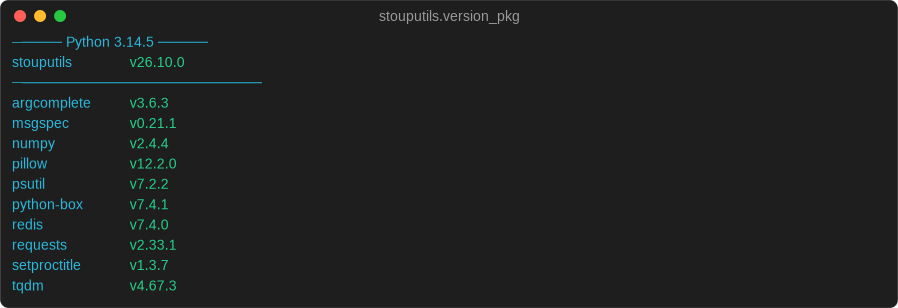
This module provides utility functions for printing package version information in a structured format, including the main package and its dependencies.
Functions:
show_version(): Print the version of the main package and its dependencies.
import stouputils as stp

# Versions of stouputils and of every package it depends on
stp.show_version()
- class VersionPrinter(
- main_package: str = 'stouputils',
- primary_color: str = '\x1b[96m',
- secondary_color: str = '\x1b[92m',
- max_depth: int = 2,
- fully_displayed: set[str] = <factory>,
Bases:
objectPrints a package and its dependencies, either as a flat list or as a tree.
>>> VersionPrinter.dependency_name('msgspec[toml,yaml]>=0.20.0')
'msgspec'
>>> VersionPrinter.dependency_name('numpy; python_version >= "3.14"')
'numpy'
- fully_displayed: set[str][source]#
Packages whose dependencies were already printed once, collapsed into one line on the next occurrence.
- static version_of(package_name: str) str[source]#
Installed version of a package, empty when it is not installed.
- Parameters:
package_name – Name of the package
- Returns:
“1.0.0”
- Return type:
Version of the package, ex
- static dependency_name(requirement: str) str[source]#
Name of the package a requirement refers to, without its version, extras or markers.
- Parameters:
requirement – Requirement as written in the metadata, ex: “msgspec[toml,yaml]>=0.20.0”
- Returns:
“msgspec”
- Return type:
Name of the required package, ex
- classmethod dependencies_of(
- package_name: str,
- with_extras: bool = True,
Sorted names of the packages a package depends on, without duplicates.
- Parameters:
package_name – Name of the package
with_extras – Whether the dependencies of the optional extras are included
- Returns:
[“numpy”, “tqdm”]
- Return type:
Names of the dependencies, ex
- separators(length: int) tuple[str, str][source]#
Build the two separator lines framing the main package.
- Parameters:
length – Width of the separators, in characters
- Returns:
Separator holding the Python version, and plain separator
- property minimum_width: int[source]#
Width leaving at least five dashes on each side of the Python version.
- package_line(
- package_name: str,
- version: str,
- suffix: str = '',
Build the line describing one package.
- Parameters:
package_name – Name of the package
version – Version of the package
suffix – Text written after the version, ex: the already shown marker
- Returns:
“stouputils v1.0.0”
- Return type:
Colored line, ex
- already_shown_line(
- package_names: list[str],
Build the line collapsing every dependency whose own tree was printed earlier.
- Parameters:
package_names – Names of the packages already printed
- Returns:
“Already shown ^: markdown, pygments”
- Return type:
Colored line, ex
- static indent_block(
- lines: list[str],
- is_last: bool,
Hang a subtree under its parent, the first line carrying the connector.
- Parameters:
lines – Lines of the subtree, indented relative to its own root
is_last – Whether the subtree is the last child of its parent
- Returns:
Lines indented relative to the parent
>>> VersionPrinter.indent_block(["numpy", "└── tqdm"], is_last=False)
['├── numpy', '│   └── tqdm']
>>> VersionPrinter.indent_block(["numpy", "└── tqdm"], is_last=True)
['└── numpy', '    └── tqdm']
- render_tree(
- package_name: str,
- visited: frozenset[str] = frozenset({}),
- depth: int = 0,
Render a package and its dependencies, indented relative to that package.
Dependencies whose own tree was printed earlier are collapsed into a single line at the end, since repeating their name, version and marker on one line each drowns the ones worth reading.
- Parameters:
package_name – Name of the package to render
visited – Packages already rendered in this branch, to stop cycles
depth – Current depth, the main package being at 0
- Returns:
Lines of the subtree, the package itself being the first one
- show_version(
- main_package: str = 'stouputils',
- primary_color: str = '\x1b[96m',
- secondary_color: str = '\x1b[92m',
- max_depth: int = 2,
Print the version of the main package and its dependencies.
Used by the “stouputils –version” command.
- Parameters:
main_package – Name of the main package to show version for
primary_color – Color to use for the primary package name (defaults to cyan)
secondary_color – Color to use for the secondary package names (defaults to green)
max_depth – Maximum depth for dependency tree (<= 2 for flat, >=3 for tree)